

Steel T-Beam Bending
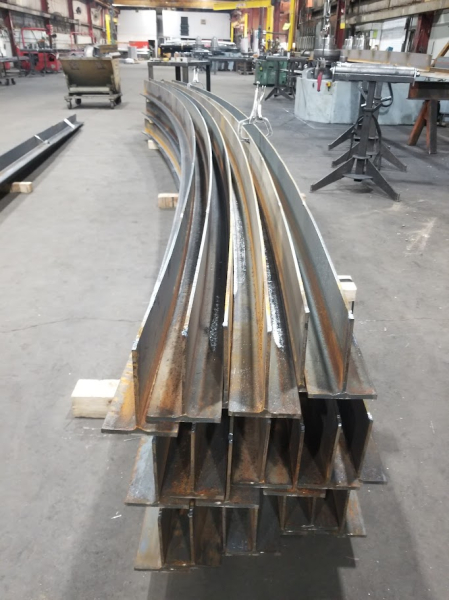
Linders Specialty Company provides precision tee beam bending in all three rolling orientations: stem-in, stem-out, and hard way. T-shape steel beam bending provides tight tolerances and high repeatability for structural, architectural, and industrial applications.
Located in St. Paul, Minnesota, and serving fabricators and contractors across the United States, Linders operates an extensive lineup of rolling machines and tooling dies to match every T-beam project to the right equipment, minimizing distortion, reducing material waste, and keeping your project on schedule.
Request a quote, or contact us with your steel T-beam questions today.
What Is a Steel T-Beam?
A steel T-beam (also called a tee beam or T-shape steel beam) is a structural steel profile with a cross-section shaped like the letter T, consisting of a vertical web (stem) and a horizontal flange. Steel T-beams are most commonly produced by splitting a standard wide-flange or I-beam longitudinally down the center of the web, a process that yields two T-shaped sections from a single beam. This splitting process is performed using a cutting torch, plasma cutter, or saw, and the resulting tee sections retain the flange of the original beam as the top plate, with the cut web forming the stem.
Efficient Material Distribution
The T-beam profile is widely used in structural steel applications for its efficient material distribution, concentrating steel in the flange where bending stress is highest. At the same time, the stem provides shear resistance and connection geometry. Steel T-beams are available as standard WT (wide flange tee) sections cut from W-shapes, as well as ST sections cut from standard S-beams, across a broad range of flange widths, stem depths, and weights per foot.
T-Beam Bending Orientations
Tee beam bending is more complex than rolling standard beams because the asymmetric T-shape cross-section responds differently to bending forces depending on its orientation relative to the rolling axis. Linders Specialty Company has the equipment, tooling, and process expertise to roll steel T-beams in all three orientations, selecting the optimal machine and die configuration for each to minimize distortion and maintain dimensional integrity.
Tee Stem Out — Easy Way
Tee Stem In — Hard Way (Flange Out)
Tee Hard Way — Web/Stem Vertical
Common Applications for Curved Steel T-Beams
Linders Specialty Company's rolled steel T-beams and tee beam bending services support a broad range of structural, industrial, and architectural applications across the industries we serve:
- Curved roof structures and canopies
- Architectural feature arches
- Amusement Park Structures
- Bridge and elevated structure components
- Mezzanine and building framing
- Transportation and transit infrastructure
- Heavy equipment and machinery frames
- Storage tank components and stiffener rings
- OEM fabricated assemblies
- Energy sector structures
Advantages of Steel T-Beams
Steel T-beams offer a distinct set of structural and fabrication advantages that make them the preferred profile for a range of applications where standard wide flange or channel sections are less efficient:
- Efficient Material Distribution
- Versatile Connection Geometry
- Available in a Wide Range of Sizes
- Effective as Curved Structural Members
- Suitable for Multiple Materials
Value-Added Services for Rolled T-Beams
Linders Specialty Company's T-beam bending capability is supported by a full range of value-added fabrication services, allowing customers to receive finished or semi-finished curved tee sections ready for installation or assembly:
- Trimming and beveling of rolled T-beam ends for weld fit-up
- Sawing and plasma cutting to length
- Hole punching and drilling for connection hardware
- Welding services for fabricated assemblies incorporating curved T-beams
- Metals, services, and fabrication
- Metal forming and cutting
- Surface finishing, including paint, powder coating, sandblasting, and corrosion prevention treatments
Additional Bending & Rolling Capabilities
Looking for a different steel bending or rolling option? Explore our related bending and rolling capabilities:
Precision Tee Beam Bending from Linders Specialty Company
Linders Specialty Company has been rolling and fabricating structural steel for customers across the United States from our St. Paul, Minnesota, facility for decades. Our investment in a broad range of rolling machines and tooling, combined with operator expertise that matches every T-beam project to the right equipment, means customers get accurate, repeatable curved T-shaped steel beams with minimal distortion and competitive lead times.
Whether the project calls for a single curved T-beam for an architectural feature or a production run of rolled WT sections for a structural steel contractor, Linders has the capacity and capability to deliver. Request a quote, or contact us with any questions.


